1. Macro Crisis: The Sudden Collapse of Passive Luxury Tourism
The Southeast Asian luxury retail landscape is undergoing its most radical shift in a decade. For years, flagship boutiques in Jakarta, Bangkok, Singapore, and Kuala Lumpur enjoyed passive prosperity driven by an influx of high-net-worth foreign tourists. High-ticket items sold organically without requiring aggressive clienteling from store staff.
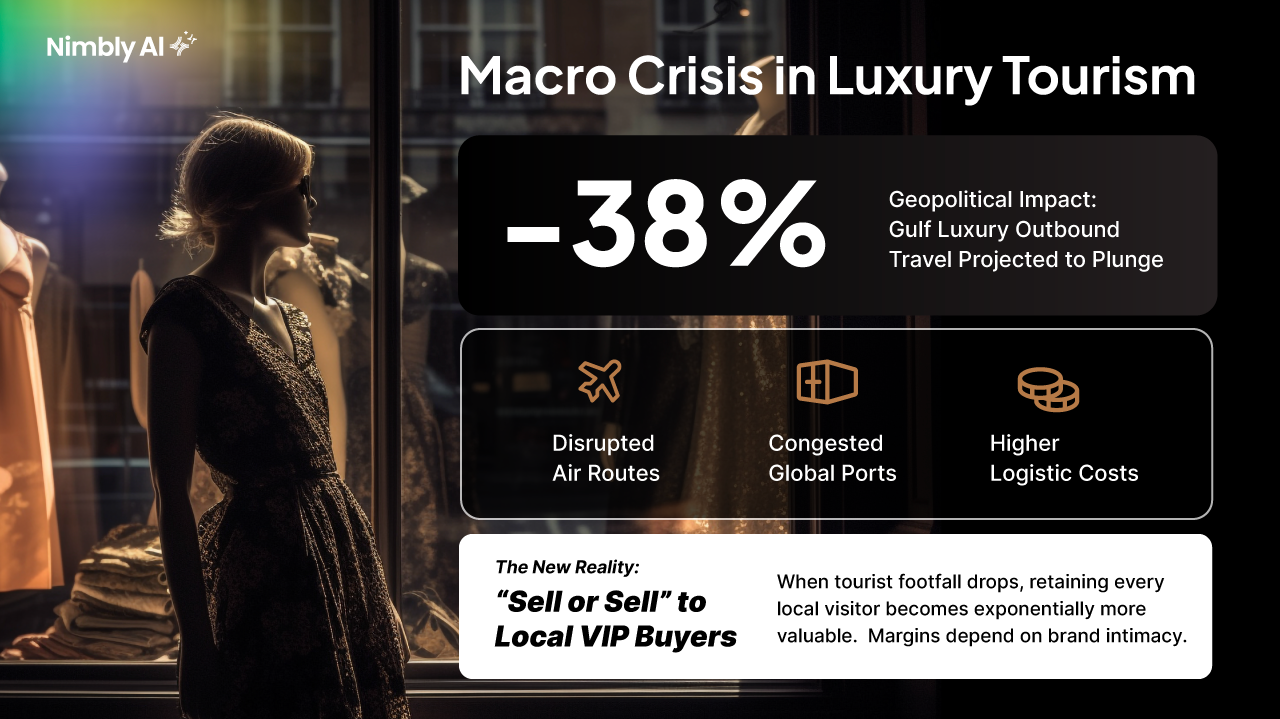
However, that period abruptly ended. The closure of major maritime routes in the Strait of Hormuz and global geopolitical unrest disrupted international flight paths and surged logistics costs. The high-end sector is facing a significant impact from the domino effect, with passive luxury tourism growth projected to decline by as much as 38% (UN Tourism & Retail Asia Economic Outlook).
Amid dwindling tourist footfall and soaring boutique operational costs, retailers are trapped in a stark reality: “sell or sell.” Domestic local consumers must now fully absorb all inventory allocated to the Southeast Asian market.
The implication is clear: when tourists disappear, each local visitor becomes exponentially more valuable. Unlike impulsive tourist shoppers, local VIP buyers demand brand intimacy, personal recognition, and long-term relationships. Ignoring a single prospective local buyer is no longer just a missed sales opportunity—it is a tangible margin loss that threatens the boutique network.
2. The Core Finding: High Intent, Zero Price Resistance, Huge Experience Gap
When sales decline during a crisis, top management often defaults to blaming external factors. Executives and commercial teams frequently assume that drop-offs in conversions stem from weakening purchasing power, or they dismiss visiting shoppers as mere window shoppers. However, buyer behavior data and baseline field observations reveal a strikingly different reality:
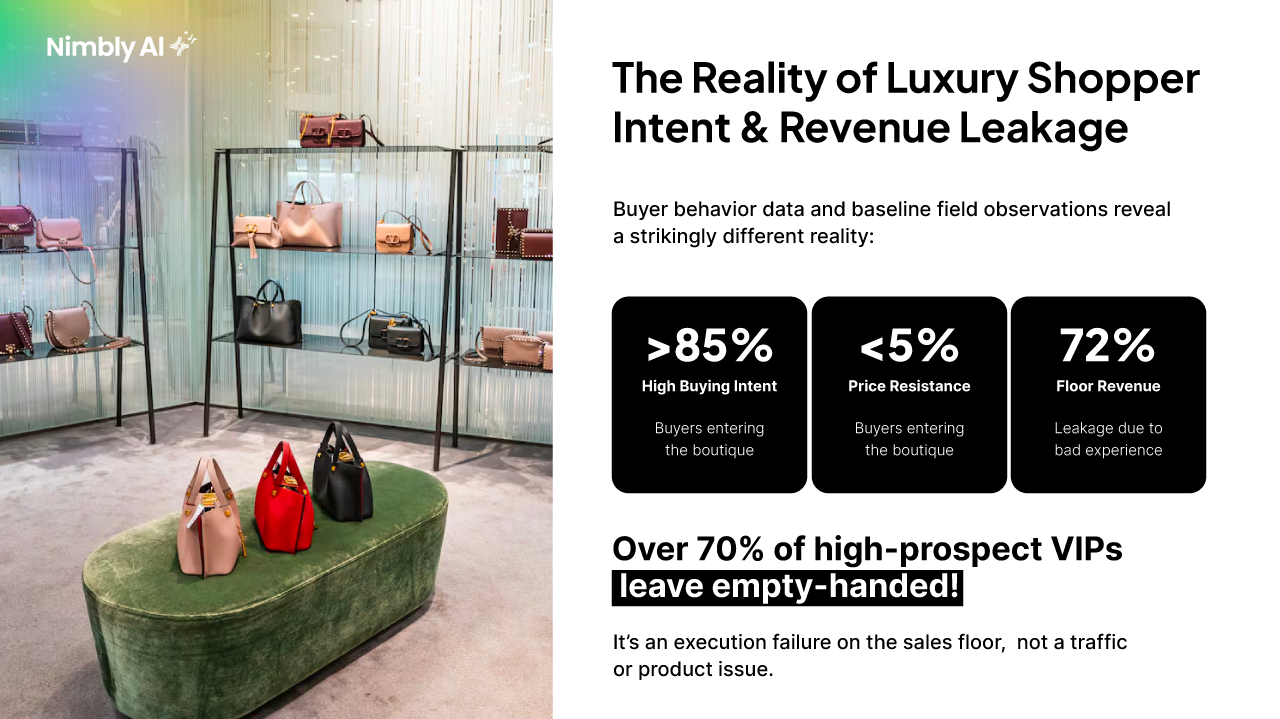
- Extremely High Purchase Intent (>85%): High-end retail behavioral research from Harvard Business Review reveals that over 85% of visitors stepping into a luxury boutique actually possess highly specific purchase intent or strong interest in a particular collection. The proportion of visitors who drop by without any buying intent is minimal (around 6%).
- Minimal Price Resistance (<5%): An Econsultancy study shows that price concerns trigger less than 5% of abandoned transactions. High-end consumers do not visit luxury boutiques hunting for discounts; they come seeking brand heritage, material authenticity, and exclusivity.
- Sales Floor Revenue Leakage (72%): A joint study by Harvard Business Review and Deloitte highlights that up to 72% of in-store purchase cancellations are caused by failures in the in-store customer experience and unproactive staff, rather than a lack of buying interest.
This baseline data exposes a painful truth: over 70% of high-prospect VIP buyers walk out of boutiques empty-handed. The primary issue is an execution breakdown on the sales floor, not a lack of shoppers or unappealing products. Revenue is leaking right in front of store managers, and luxury retailers must act on these findings immediately.
3. Finding the Root Cause: Why Do More Than 70% of Luxury Shoppers Leave Empty-Handed?
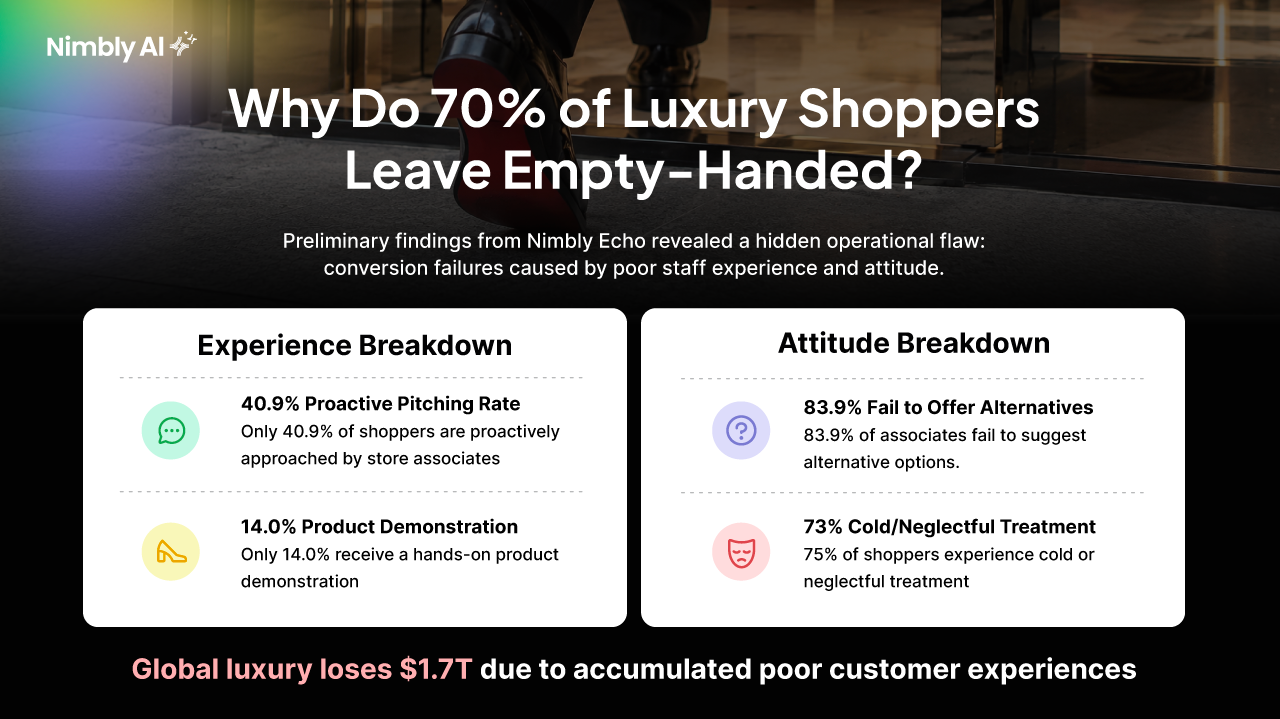
Why does such massive revenue potential evaporate right at the point of sale? Preliminary findings from Nimbly Echo uncovered an operational blind spot that management had previously been unable to measure. This conversion failure is driven by critical breakdowns across two primary dimensions: experience and attitude.
3.1. Experience (Product Education & Engagement)
In luxury retail, experience is not merely defined by beautiful interiors or pleasant ambient scents; it is shaped by the dynamic dialogue between the Client Advisor and the guest. Yet data shows that the quality of interaction on the sales floor consistently falls short of luxury standards:
- Low Initiative in Proactive Pitching: Store staff take the initiative to offer recommendations or pitch products in only 40.9% of interactions. This means nearly 6 out of 10 visitors explore the store without receiving proactive guidance from staff.
- Minimal Product Education & Demonstrations: Staff introduce and demonstrate new collections to only 14.0% of visitors. Yet when staff proactively educate guests and showcase products, the positive response rate soars to 52.9%. The inconsistent product storytelling results in a significant loss of revenue potential.
3.2. Attitude (Staff Demeanor & Responsiveness)
Passive and stiff staff interactions, combined with a lack of emotional resonance, result in an experiential gap.
- Frontline Dismissal: When a requested item is out of stock on the display shelf, staff frequently end the interaction with a cold statement: “Sorry, this variant is sold out.” Initial Nimbly Echo findings show that 83.9% of staff fail to offer alternative collections available in-store, severing emotional connection and halting upselling potential.
- Absence of Emotional Connection: The Shopper Dismissal & Luxury Retail Service Gap Study indicates that 73% of VIP shoppers report experiencing cold treatment, neglect, or subtle bias from luxury boutique staff during their initial visit. Consequently, these VIP clients abandon their purchases and never return (permanent churn). IHL Group reports that the luxury retail industry loses up to $1.7 trillion globally due to accumulated poor customer experiences.
4. The Operational Paradigm Shift: Turn Your Luxury Store Into an Experience Center
To stop revenue leakage on the sales floor, luxury retail leaders must execute a fundamental operational shift through two strategic imperatives:
4.1. Transforming Store Functions: From Passive POS to Experience Centers
Physical stores can no longer operate merely as static display rooms or passive checkout points (Points of Sale). As tourist traffic contracts, retail locations must evolve into Experience Centers—curated spaces where local VIP buyers immerse themselves in brand culture, heritage storytelling, craftsmanship, and tailored clienteling.
Transitioning to an Experience Center requires moving from transactional mass sales to relationship-driven retailing. A study by Bain & Company shows that implementing personalized clienteling focused on brand storytelling can increase customer Lifetime Value (LTV) in the luxury sector by up to 3.5 times. Furthermore, Deloitte research confirms that retaining and nurturing existing local VIP clients is up to 5 times more cost-effective than burning marketing budgets to acquire new shoppers in a low-tourist environment.
4.2. Blind Spots of Legacy Retail Metrics
Headquarters cannot manage or improve Experience Center performance using legacy measurement tools that suffer from severe operational blind spots:
- Door Sensors: Count raw foot traffic indiscriminately—including staff, security, cleaning crews, and delivery personnel. This skews actual conversion rates and distorts store analysis.
- POS Systems: Act as a black box; while they record successful transactions with precision, they offer zero visibility into why more than 70% of visitors walk out without buying.
- Mystery Shoppers: Provide only an artificial, staged snapshot. They fail to capture organic daily pressures, authentic customer responses, or staff behavior during peak hours.
HQ requires full transparency into sales floor interactions long before a register receipt is printed.
5. Winning the Future of Luxury Retail: Conversation Intelligence with Nimbly Echo
To eliminate execution gaps and illuminate sales floor blind spots, Nimbly AI introduces Nimbly Echo: an AI Conversation Intelligence solution that transforms unrecorded verbal interactions into actionable, objective operational insights.
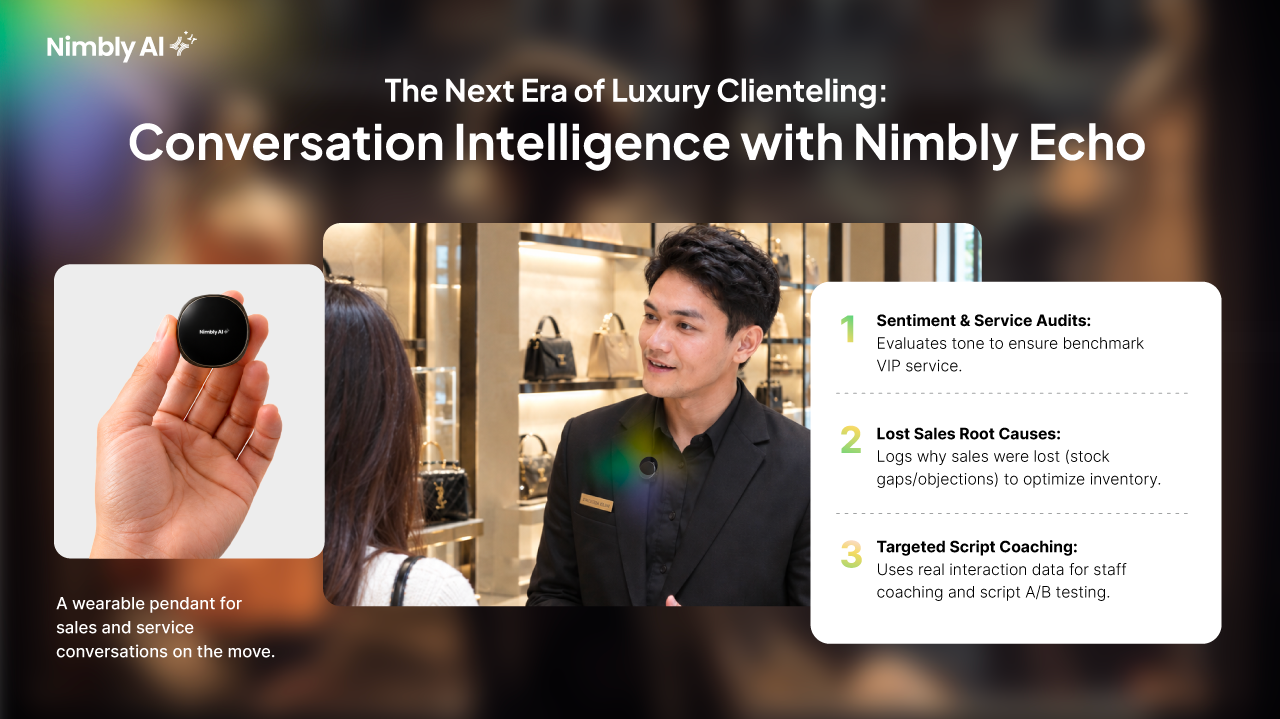
Nimbly Echo serves as an integrated operational guide across key in-store touchpoints using Echo Go, a lightweight device worn by sales floor staff to capture clienteling compliance, storytelling depth, objection handling, and product demonstration effectiveness without intruding on guest comfort.
Through retail-contextual AI processing, Nimbly Echo delivers clear operational intelligence to headquarters:
- Sentiment Analysis & Service Quality Audits: Objectively evaluates tone and warmth to ensure every VIP guest experiences benchmark service standards.
- Uncovering Root Causes of Lost Sales: Automatically logs exact reasons behind abandoned transactions—whether due to inventory gaps or specific objections—giving commercial teams precise data for inventory adjustment.
- Targeted Coaching & Script Optimization: Delivers real-world interaction data for Store Managers to coach staff individually and A/B test high-performing communication scripts before network-wide rollout.
In today’s evolving luxury landscape, boutique grandeur and store size no longer solely determine long-term success. Allowing boutiques to function as passive cashiers poses an unsustainable risk to operating margins when local traffic becomes more important and tourist footfall decreases.
The future of luxury retail belongs to brands that transform physical boutiques into Experience Centers—spaces where every Client Advisor consistently converts visitor intent into lasting relationships and optimal inventory absorption.
Through Nimbly Echo, Nimbly AI empowers retailers to uncover hidden revenue leaks, eliminate operational blind spots, and enable frontline teams to deliver flawless luxury service consistently.
We would love to partner with you to streamline your operations. Request a free consultation today to get started!